Promotions and discounts that really work: how to increase sales without losses
Just making a discount is not yet a strategy
When sales start to subside or you want to quickly push customers to buy, the first idea that comes to mind most entrepreneurs — is to make a discount. This seems like an obvious solution: if it gets cheaper, people will buy more. Sometimes it really works. But much more often — is not.
The problem is that a discount itself is not a tool if there is no logic behind it. It turns into a chaotic action that can give a short surge in sales, but does not create a stable result. Moreover, in some cases it even harms business.
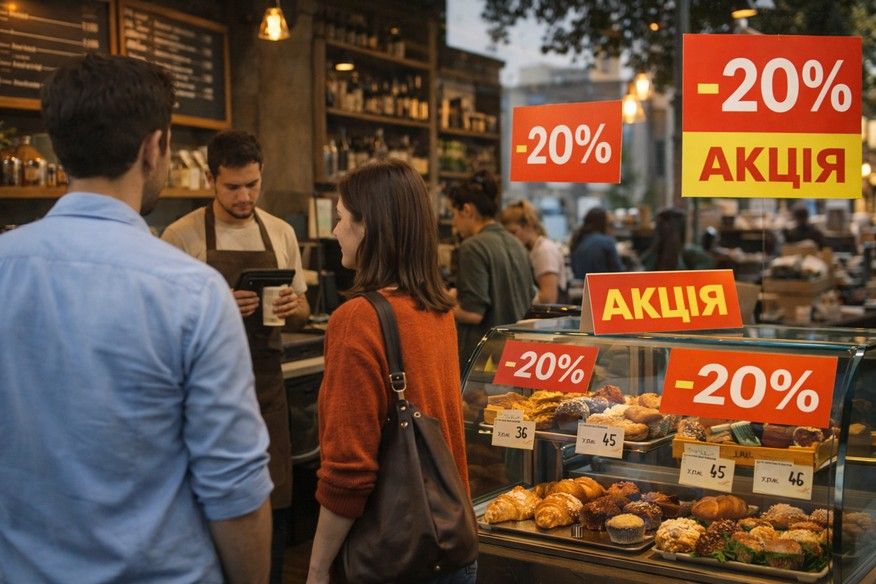
Imagine the situation: the institution regularly makes “minus 20% on all”. At first, customers react actively — it looks like a good deal. But very quickly there is a change in behavior. People start waiting for discounts and don't buy at the full price. As a result, the business itself teaches its customers to pay less.
This is one of the basic marketing effects: the customer remembers not the price itself, but the habit of it. If you regularly reduce prices without a system, a new norm is formed, and it becomes very difficult to go back.
Another typical situation is — shares “for tick”. For example, when there is a discount, but it is not clear to the client: it is not clear what it applies to or when, why right now, whether there is a real benefit in this. In such cases, people simply do not react, even if the proposal is objectively good.
The client does not analyze deeply. He does not count percentages and does not compare mathematically. It evaluates very simply: “is profitable and understandable” or “is something difficult, I don't want to understand”.
That is why effective promotions — are not about the size of the discount, but about its meaning. When the client understands why it is profitable right now and for him, he reacts much more actively. And here it is important to change the approach:
👉 shares — is not a way to save sales, but a tool for managing customer behavior.
When you understand this, discounts stop being chaotic and start working as part of the system.
Why people buy more: a simple psychology of solutions

For stocks to really work, you need to understand one key thing: most — purchases are not rational. People like to think that they choose logically, but in reality decisions are often made quickly, at the level of feelings, and only then are they explained to themselves as rational.
For example, a typical situation: a person goes for coffee, but comes out with coffee and dessert. Did she plan it in advance? Most often — is not. It's just that there was a feeling in the moment that it was appropriate, pleasant or beneficial. And this is exactly what the shares work on.
There are several basic principles that are constantly repeated in the behavior of buyers. One of them is — sense of benefit. It is important for a person not just to buy, but to feel that he has made the right choice. That is why phrases like “are more profitable together” or “special offer” work even when the price difference is small.
Another strong factor is — limitation. When the offer is valid “only today” or “from 12:00 to 15:00”, the decision is made faster. The desire to think and postpone the purchase disappears, because there is a feeling that the opportunity may disappear.
This is clearly visible in real life. For example, in coffee shops, “happy hours” often work better than permanent discounts. Not because they are bigger, but because they are limited in time. A person does not think “will come in once”, he thinks “needs now”.
Another important point — is the simplification of the choice. When a client is offered a ready-made solution, it is easier for him to agree. For example, offering “coffee + dessert at a special price” looks easier than having to choose two products separately and count their amount.
This is the essence of marketing in daily business: not to force the client to buy, but to create conditions in which it is easy for him to agree.
And here it is important not to complicate. The simpler the offer, the stronger it works. When the client needs to count something, analyze or think for a long time — the effect weakens significantly. Therefore, the most effective shares of — are those that are perceived instantly. A person sees the offer and immediately understands: “is profitable, I take”.
Combo offers: how to increase the average check without pressure
One of the most common mistakes in — sales is trying to sell something extra to the customer due to direct pressure. Classic: “take more of this”, “can more dessert?”, “add something to order?”. Sometimes it works, but often causes a backlash — the person refuses, even if it might suit them. The reason is simple: the client does not like to feel that he is being pressured.
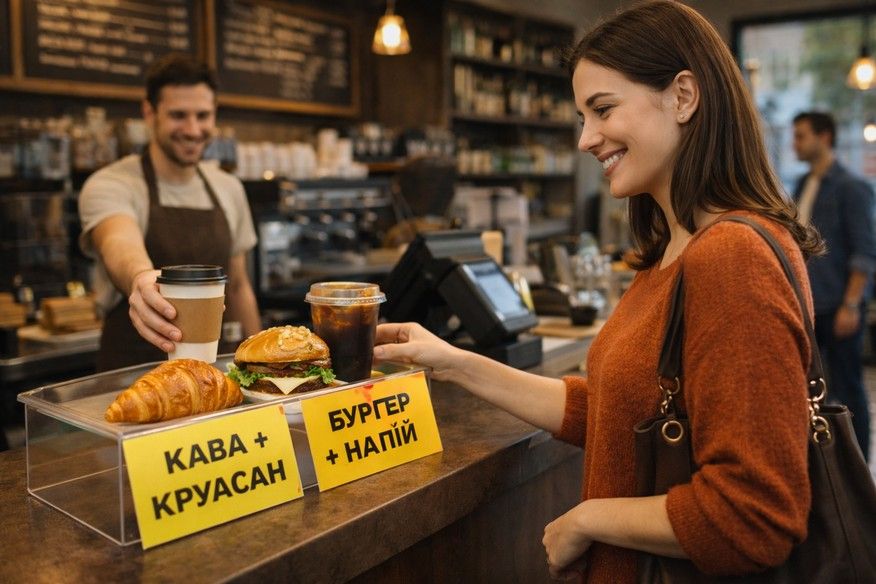
That is why combo offers work much more efficiently. They do not force to buy more — they offer a ready-made solution that looks logical and profitable. From the client's point of view, this has a completely different appearance. He doesn't feel like he's being sold anything. He sees a convenient option: an already selected set that solves his need faster and easier.
Imagine the situation. A person walks into a coffee shop for coffee. If she is offered to just add dessert, she can refuse — did not plan, does not want to spend more. But if she sees an offer of “coffee + dessert at a special price”, the perception changes. Now this is not an additional purchase, but a profitable set.
An important marketing principle works here:
👉 people respond better to ready-made solutions than to individual options.
Combo removes the need for the client to think. He does not need to compare, count, decide. It has already been chosen — and it creates a feeling of simplicity.
It works the same way in stores. For example, when next to the main product there is a logical addition in the format of a set. A person does not think: “do I need it yet?”, - he thinks: “is so more convenient”.
But it is important not to overdo it. The combo should look natural. If the set seems artificial or includes what the client does not need —, the effect disappears.
Those combinations that correspond to the real behavior of the buyer work best. What people buy together already often — is simply presented in a more convenient form. That is why combo — is not a way to make “cheaper”, but an opportunity for “to make it easier”. And simplicity, as we have already said, directly affects sales.
Discounts: when they really work
Discounts — is one of the most powerful tools in sales. But only when they are used correctly. The paradox is that the discount itself does not guarantee the result. If it is perceived as something permanent or accidental, the client stops reacting to it. She becomes the background. For a discount to work, it must have meaning and context.
For example, a temporary offer is always perceived more strongly than a permanent one. When the customer realizes that the discount is valid for a limited time, he makes a decision faster. He gets the feeling that an opportunity can be missed. This is the same principle that we see in everyday life: when something is available always — we delay, when there is a limit — we act.
Another important point is — specifics. The discount should be clear immediately. If the client needs to understand the conditions, count or specify the — effect drops sharply. For example, a simple and clear offer of “-20% on the second position” works better than complex conditions with several restrictions. A person immediately understands what it means and how to use it.
It is also important that the discount does not devalue the product. If the discounts are constant and large, the client gets the feeling that the real price is lower. As a result, he is simply not ready to pay the full cost. Therefore, effective discounts — are always a balance. They should:
- be clear,
- have cause or pretext,
- to look like an opportunity, not like the norm.
And another important nuance that is often ignored: the discount should stimulate action, and not just exist. If it does not change the behavior of the client — it does not work. That is why it is worth not just lowering prices, but watching how it affects sales. Do they buy more? Does behavior change? Is the number of checks increasing?
“Happy hours”: how to fill weak periods
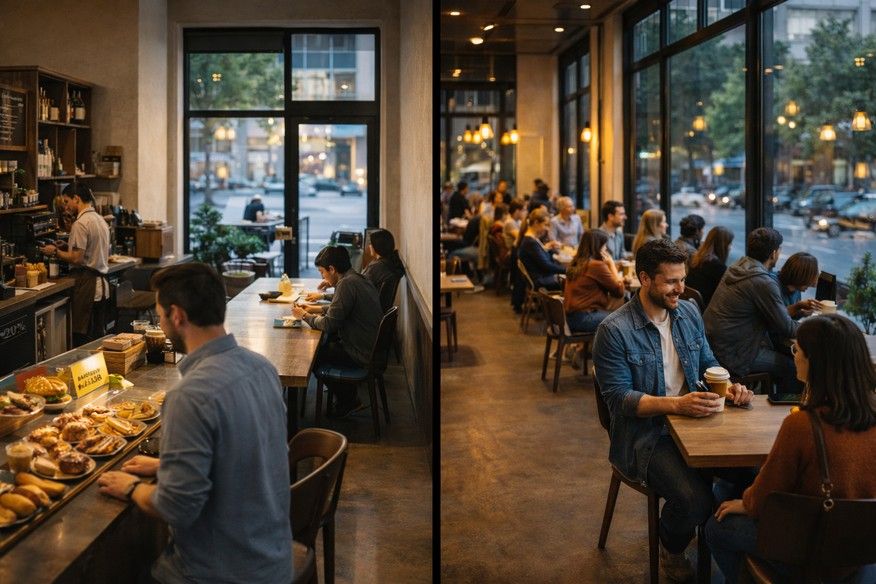
There is a pattern in any business: the flow of customers is uneven. There are hours when there are many people and there are moments when it is almost empty. This is normal — but this is where the great potential for growth lies.
Most entrepreneurs perceive “quiet hours” as something negative and inevitable. But in reality, this is not a problem, but an opportunity. If you look more closely, during these periods the business already has everything it needs: the staff is on site, the equipment is working, the costs are already there. But — customers are few. This means that every additional sale at this time is much cheaper than during peak hours. This is where “happy hours” work - not just a discount, but a way to change customer behavior and move part of the flow to a less busy time.
For example, if the coffee shop has the main influx in the morning and evening, and the afternoon is quiet —, it is logical to stimulate people to come during this period. But it is important not just to make it cheaper, but to give an understandable reason. When a customer sees: “from 12:00 to 15:00 special offer”, they have a new behavior scenario. He can change his — habits, for example, not go in after work, but at lunch.
This is clearly visible in everyday life. People often adjust to favorable conditions, even if it means changing their plans a little. Not radical, but enough to affect your customer flow.
And here an important principle works:
👉 client does not need to force — to create the right motivation enough.
“Happy hours” are especially effective when they:
- clearly time-bound,
- easily understood,
- linked to a specific benefit.
If they look like something blurred or a constant — effect disappears. People stop seeing it as an opportunity and delay decisions.
Another important point is — regularity. When customers know that there is always a good deal at a certain time, it creates a habit. And this is no longer a one-time promotion, but a stable flow. As a result, “happy hours” helps not just to increase sales, but to make them more even. And this means — more predictable and manageable.
How not to lose profit through shares
Shares can increase sales. But they can just as easily “eat” profit if used without control. And the most dangerous thing here is that everything seems to be fine from the outside: there are more customers, more checks, the movement is more active. Business seems to be growing. But when you look at the numbers, it turns out that there is no more money. And sometimes there are even fewer of them. To understand this, it is worth looking at a simple example.
Let's imagine a coffee shop where cappuccino is sold for UAH 80. The approximate cost price is UAH — 30, that is, UAH 50 remains from each cup. 100 cups are sold per day —, this gives UAH 5,000 of earnings to other expenses. Then the promotion is launched: cappuccino for UAH 65. Now not UAH 50 remains from one cup, but only UAH 35. But customers have become more — sold, for example, 120 cups. It seems like a success: more people, more sales. But if you count, it turns out to be different. It was UAH 5,000, it became approximately UAH 4,200. That is, the business began to work more actively, but earn less.
This is the same trap: when there are more sales and the result — is worse.
To make the promotion profitable, it is not enough to simply increase the number of customers a little. It is necessary that the increase in sales compensates for the loss of each unit of the product. In our example, after lowering the price, it would be necessary to sell about 140 cups, and not 120, in order to at least reach the same level.
It happens differently. Sometimes the promotion does not lead to new sales at all, but simply makes those that would have been cheaper. For example, if regular customers would have bought coffee without a discount, but now they bought it cheaper, the business simply did not receive money, not receiving anything in return.
That is why it is important to look not only at the number of sales, but at what is happening as a whole. Have there really been more customers? Has the behavior changed? Has the total revenue and result increased?
Another important point — stocks should not be permanent. If the customer gets used to discounts, they stop stimulating purchases and start simply reducing income. In such a case, the business itself creates a situation in which it is forced to constantly dump in order to remain competitive. The correct approach — to use stocks as a tool, not as a permanent mode of operation.
And here analytics come to the rescue. When you see the real numbers — how much you sold, when, in what period, — you can estimate what works and what doesn't. Not intuitively, but based on facts. This avoids a situation where the business “works a lot and earns little”. And the main thing is — gives control. You don't just run stocks, you manage them.
Shares — are not magic and not a guarantee of growth. It's a tool. And it only works when you understand exactly how it affects your business.
What the numbers show: how to evaluate the effectiveness of shares

When you launch a promotion, it is very easy to rate it for a feeling. It seems that there are more customers, the movement is more active, so everything works. But feelings in business are often let down.
What looks like growth does not always mean a real result. That is why it is important to look not only at activity, but at numbers. And here you don't need complex analytics or special knowledge. It is enough to understand several basic indicators and check them regularly.
First of all — number of checks. It shows whether there are more purchases. If there are no more checks after the launch of the promotion, this is a signal that it does not change the behavior of customers.
Second important point — total sales for the promotion period. It gives an understanding of whether revenue has really increased, not just activity.
But the most valuable — is matching. A single number says almost nothing. It is important to see how the indicators have changed:
- before and during the action,
- оn different days,
- at different hours.
For example, if you made “happy hours”, it is logical to see what happened at that time before and after launch. Have there been more sales? Has a new flow of customers emerged? Such comparisons give a real picture.
In modern business, this is especially important, because intuition often does not suggest what is really happening. It may seem that there are many people, but this is not reflected in the numbers. Or maybe vice versa — small changes give a stable increase that is not always immediately noticeable. That is why reports and analytics created with the help of systems such as Kavapp become not just an additional function, but a management tool.
When you regularly look at sales, at the number of checks, at the dynamics at different periods, you begin to see patterns. You understand what works and what doesn't. And most importantly, — can adjust it. As a result, the business stops working “on sensations” and starts working on the basis of facts.
Shares — is a tool, not a lifeline
Promotions, discounts, combo offers — are strong marketing tools. They can significantly affect sales, change customer behavior and help businesses grow. But only under one condition: if they are used consciously.
When stocks become chaotic, when they are launched without a clear purpose and without analysis, they stop working as a tool and begin to harm. Business loses control, customers get used to discounts, and profits decrease.
Instead, the systematic approach gives a completely different result. When you understand why people buy more when you use combos, limited offers, “happy hours” — not by chance, but with the logic of — sales begin to grow more steadily.
And most importantly — you start to manage this process. You do not just “give a discount”, but solve a specific task: increase the average check, attract customers in weak hours, intensify the sale of certain items. And the numbers help to check if it works.
As a result, the business ceases to depend on random decisions and begins to build a system in which every action makes sense. And that's exactly the level where stability comes in.
In the next article, let's talk about an even more important thing: you have increased sales — but how to make customers come back again and again? Let's analyze how regular customers are formed, why they are the basis of income and how to make your business chosen not once, but regularly.
Read Also


