Why your business sells but doesn't make money

Sales ≠ profit: the main mistake of entrepreneurs
There is one very common situation in business: sales are growing, there are more customers, the movement in the establishment or store is active —, and for some reason no money is added. Sometimes the opposite is true: at the end of the month, the entrepreneur sees that he has worked a lot, and the result — is minimal or even negative.
The reason is that many subconsciously equate sales with earnings. It seems logical: if you sold 100 thousand hryvnias —, then you earned this 100 thousand. But in reality, this is only revenue, that is, all the money that passed through the cash register. And only a small part of them — is your real income.
To feel it, imagine a simple situation. You sell coffee. They received UAH 10,000 in revenue per day. Sounds good. But from this money you need to pay grain, milk, cups, rent, barista salaries, taxes, utilities. And when you subtract all this, it may turn out that “net” has UAH 1,000 left. And sometimes — and less.
It is here that the key awareness arises: a business can actively sell and at the same time hardly earn. And in some cases — even lose money, it's just not immediately visible.
Another common trap is — sensation orientation. When there are many people in the institution, the cash register works without stopping, the illusion of success is created. But business — is not just a flow of customers. This is the balance between income and expenses. And if this balance is not controlled, you can work “to zero” for a long time without understanding it.
Therefore, the first and most important step — is to stop evaluating the business only by sales. Revenue — is only the tip of the iceberg. The real picture starts where you look at what's left after all the expenses.
Where does money disappear: what you don't count
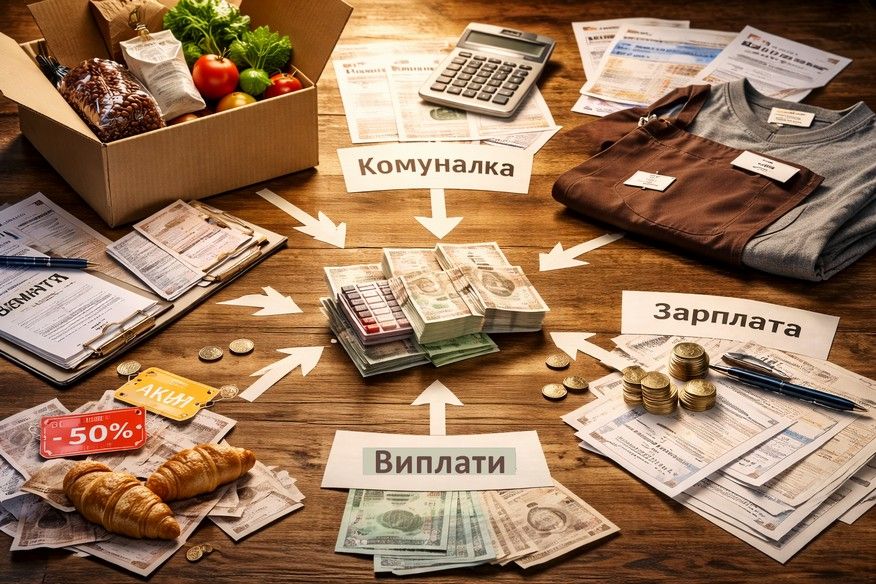
When an entrepreneur begins to understand more deeply, a logical question arises: if there are sales, where does the money go?
Most often, the answer is — in costs that seem small or “goes without saying”. They do not attract attention every day, but together they form a significant amount.
Let's start with procurement. Each product or dish has its own cost price. And if it gradually increases (for example, due to the increase in the price of suppliers), and your prices remain the same —, you automatically earn less from each sale. This happens quietly and imperceptibly, but greatly affects the result.
Next — write-offs and losses. Spoiled products, expired goods, personnel errors, improper storage. In daily work, it seems like trifles, but in a month it can turn into a tangible amount that literally eats away at profit.
Separate history — discounts and promotions. They do help increase sales, but often reduce margins. If they are used without control, you can create a situation where sales are more and earnings — are less. This is especially insidious, because it looks like business development.
Equally important are fixed costs: rent, salaries, taxes, utilities. They don't depend on how well you sell today. And even if revenue falls, these costs remain.
As a result, a typical picture is formed: money comes into business constantly, but also constantly leaves it. And if you don't see it as a system, you get the feeling that there is a problem somewhere, but it's not clear where exactly.
That is why it is important not just to look at the total amount of sales, but to understand how it is distributed. Each hryvnia has its own history: where it came from and where it went. And it's only when you start to see it that there's control over the real financial outcome.
An easy way to check if your business is making money

After you understand the difference between sales and profit, there is a need to test it in practice, without complex accounting and special knowledge. In fact, everything is simpler than it seems. To understand whether your business is making money, it is enough to answer one basic question: how much money do you really have left after all the expenses?
The mechanics here are very simple. You take the total amount of sales for a certain period —, for example, for a day, week or month — and subtract all costs from it for the same period. Not approximately, not “per eye”, but as honestly as possible: purchases, salaries, rent, taxes, utility payments, discounts, losses.
And here is the result that remains, — is the answer. If there plus — the business earns. If zero — you work without profit. If minus — the business actually eats the money.
Suppose a small coffee shop made sales of UAH 300,000 in a month. The owner is satisfied: there is a flow, the cash register works stably. But when he calculated the costs, a completely different picture came out. Purchases — 120,000 UAH, salaries — 90,000 UAH, rent — 40,000 UAH, other expenses — another 30,000 UAH. As a result, UAH 20,000 remained.
On the one hand, it is profit. On the other hand, — is not at all the 300 thousand that seemed at the beginning. And if at least one item of expenses increases slightly, this profit may disappear.
That is why it is important to count regularly. Not once a year and not when there is time, but constantly. Only then do you see not the illusion of business, but its real financial condition.
Why “on sensations” business is almost always wrong
Many entrepreneurs are guided by intuition. And it's normal — experience really helps to make decisions. But when it comes to money, intuition very often fails.
The problem is that we tend to assess the situation on external grounds. If there are — clients, then everything is fine. If many checks — means the business is growing. If the day was lively — then the revenue will be good. But these signals can be misleading.
For example, you may have a very active day with a lot of sales, but most of them are — with discounts or on low margin products. It looks like success, but financially it is a weak result.
Or another situation: the day seems quiet, there are few customers. But if they bought expensive positions with a good markup, the bottom line could be much better than on a busy day.
There is another psychological point: we remember activity better than numbers. Queuing, noise, working without pauses — it creates the feeling that the business is working at its maximum. But money is not counted according to feelings, but according to specific indicators.
As a result, the entrepreneur can be sure that everything is going well and at the same time lose money for months. And the most dangerous thing here — is not the losses themselves, but the fact that they are not immediately visible. That is why it is important to move from sensations to numbers in business. Do not give up intuition, but supplement it with real data. Then the solutions become not only quick, but also accurate.
How to see the real picture: what numbers to see
When you refuse to rate “by eye”, the following question arises: what exactly to look at to understand what is really happening to the business?
It is worth starting with the basic things that give a holistic understanding of the situation.
First of all, — is sales in dynamics. Not just “how many sold” today, but how revenue changes from day to day, from week to week. This allows you to see trends: whether business is growing or standing still, there is seasonality or sharp failures.
Next — number of checks. It shows how many actual sales have taken place. And here it is important to look not separately, but together with the proceeds. Because the same amount of sales can be formed either by a large number of small checks or by a smaller number of large ones.
Another key point — costs. Without their understanding, any sales lose their meaning. It is important to see not only the total, but also the structure: what exactly eats up the most money and how it changes over time.
Separately, it is worth paying attention to the financial result. It is he who gives the answer to the main question: does the business earn. And this indicator should be monitored regularly, not after the fact.
And finally — behavior changes or periods. On different days and hours, the business can work differently. Somewhere there are sales peaks, somewhere — empty hours. Understanding this helps to better manage resources: personnel, procurement, schedules.
The key idea here is simple: it is important to look not at one figure, but at the picture as a whole. When all these indicators are combined, the business ceases to be a black box and becomes an understandable system that can be controlled and improved.
What helps to see a business without illusions

When you start looking at a business through numbers, it quickly becomes clear: counting by hand is long and inconvenient. The data is scattered: something in the head, something in a notebook, something in different tables - in this mode it is difficult to see the full picture, not to mention regular analysis.
That is why at some point there is a need for a system that does not just collect numbers, but allows you to see the business holistically. In «Kavapp», this is implemented in the «Reports» section of the administrative panel. Its logic is simple: you choose the desired report type, set the period — and get clear numbers that can be analyzed immediately. And here the most interesting thing happens.
Let's imagine the real situation. At the end of the month, you open the reports and for the first time look at the business not “by sensations”, but through the numbers.
Total revenue — UAH 360,000. At first glance, a good result. The institution worked actively, there were many customers, there were almost no days without movement. But then you look deeper. Number of checks — 4,500. You make a simple calculation and receive an average check of about UAH 80. And this is where the first question already comes in: Isn't it too low for your format?
Go to dynamic sales and see that part of the days give a stable 14–16 thousand UAH, and the other — only 8–9 thousand. The difference is almost twice. This is no longer a coincidence, but a signal that the business works very unevenly.
You open the change report and find a pattern: weak days coincide with specific changes. That is, the problem is not in seasonality and not in bad days, but in the organization of personnel work.
Next — hourly sales. And here is another insight: from 15:00 to 18:00 you have almost no sales, but the staff works in full. In fact, these hours do not even cover salary costs.
And finally — finance. You sum up the expenses for the month: purchases, salaries, rent, utility costs — and receive UAH 330,000. And here is the moment of truth: out of UAH 360,000 of revenue, you have only UAH 30,000 left.
This is a completely different perception of business. Not “we sell well”, but “we work with a very thin margin”.
And then management begins. You understand that the problem is not one — there are several of them:
- there are changes that work weaker than others;
- there are hours that are actually unprofitable;
- the average check is lower than it could be;
- costs are already on the edge where any growth will eat up profits.
You review the schedule and optimize the empty hours, leaving fewer staff. Analyze the work of weaker changes and change the approach to their organization. Think about how to raise an average check — through offers or sales structure (for example, through combo offers or changing submissions). You begin to monitor expenses (especially purchases) more carefully so that they do not grow imperceptibly.
And most importantly — all these solutions do not appear intuitively, but based on numbers, you no longer act at random.
This is the main value of the accounting system. It doesn't just show how much you sold. It answers a question that really matters: what's really going on with your business.
When you have this data, “seems” disappears. Uncertainty disappears. And control comes in. You no longer guess — you see.
A moment of insight: when a business really starts workin

Sooner or later, every entrepreneur has a moment when he begins to look at business differently. It is not related to scale, number of points or turnover. It is about the approach.
Just yesterday, decisions were made based on feelings: “seems to need more staff”, “probably, this promotion works”, “like the revenue is normal”. And today the same questions receive specific answers in numbers. And suddenly what was previously hidden becomes visible.
It turns out that some hours bring almost no sales — and you can optimize the schedule. That individual periods give a much better result — and should be emphasized. That costs are rising faster than — seems and need to be revised.
This is the moment of insight: when business ceases to be a process that simply happens and becomes a system that can be managed.
Control appears. Instead of a constant sense of uncertainty — understanding what is happening. Instead of reacting to — problems, the ability to predict them. And most importantly — comes confidence. Not because “is all good”, but because you know exactly how it really is.
It is from this moment that the business begins not just to sell, but to earn.
Read Also


