What makes buyers come in: first impression and convenience, which sell
The first seconds decide everything
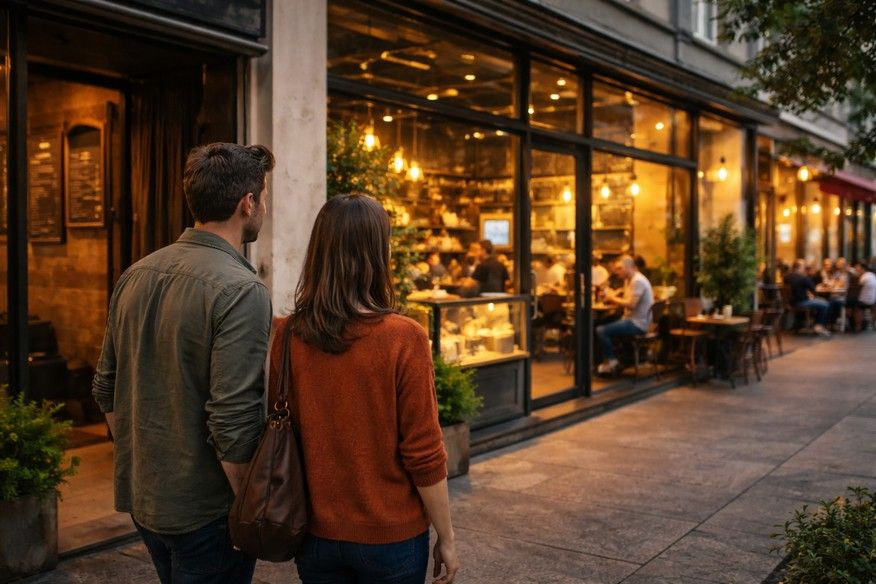
Imagine a normal situation. A person walks down the street: maybe in a hurry on business, maybe just looking for a place to drink coffee or buy something. She has no plans to analyze your business, compare prices or read reviews. She has literally a few seconds to make a decision: to enter or pass by. And it is in these few seconds that more is decided than it seems.
Most entrepreneurs think that the main thing — is a product: delicious coffee, quality product, good price. And that's true. But there is one important detail: the customer will not be able to evaluate your product if it does not come to you. And he decides to enter not by logic, but by feeling. A person looks at the institution and instantly answers a few simple but very important questions:
- “Is it clear what is sold here?”
- “Will be convenient for me here?”
- “I will get what I want quickly?”
If at least one of them is answered by “not very” —, it just goes further.
This is not an exaggeration. In real life, customers do not give a second chance. They do not come closer “to understand”, do not ask, do not specify. They choose where everything looks simple and clear at first glance.
That is why businesses with the same product can have completely different results. One — with queues, the other — with almost no clients. The difference is often not in the quality of the product, but in what it looks like and how the purchase process itself is perceived. And here it is important to understand the main thing:
👉 sales do not start at the box office. It begins even before a person enters.
First impression: what the client actually sees
When talking about the first impression, many immediately think about design or repair. But in practice, this is a much broader concept. The customer does not rate your interior as a designer. He evaluates how understandable and comfortable he is.
Look at it through the eyes of the buyer. He approaches an establishment or a store and literally reads the situation in a few seconds: whether it is clean or light, whether it is clear what is being sold here, whether everything looks too complicated.
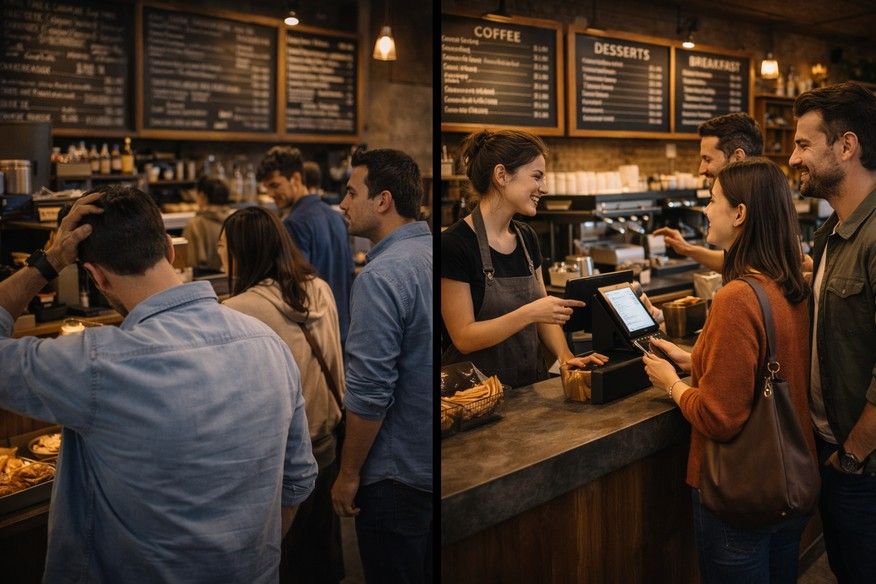
Let's imagine the situation: there are two cafes nearby. In one — simple, clear menu, you can see the prices, there is a sense of order. Otherwise, — is nice interior, but the menu is somewhere on the side, fine text, obscure titles. Where will most people go? In the first. Not because it is better to cook there. And because it is easier to make a decision there.
Or another example with a store. You go in and immediately see where what is. Categories are clear, prices are visible, there is no sense of chaos. In such a space, you want to stay longer and choose something. And now the situation is different: the goods are laid out without logic, the prices must be sought, the seller is busy. The client has a slight strain of — and exits quickly.
This is the first impression. It consists of simple things: not “beautiful or ugly”, but “clear or unclear”, “convenient or inconvenient”.
And most importantly: the client does not formulate it in words. He just feels: “I like” here or “something is wrong”.
Therefore, a business that is perceived as simple and clear always has an advantage. Even if there are more stylish or expensive competitors nearby.
In the following sections, we will analyze exactly how to make it so that the client is not just normal, but as easy and comfortable as possible — so much that he not only comes in, but also wants to buy.
Menu or assortment: when everything is clear at first glance
After the customer decides to log in, you have the next few minutes — and they are no less critical. It is at this moment that a person tries to understand: what to buy here and how easy it will be.
And here many businesses lose a client. The problem is not that you have few products. More often, on the contrary, — there are too many of them, and they are presented in such a way that it is difficult for a person to understand.
Remember your own experience. You open the menu, and there are dozens of items, unclear names, chaotic structure. You start reading... and get tired in a minute. At this point, the thought comes up: “Maybe go to a place where it's easier?”
This is a very important point:
👉 difficulty does not sell. She repels.
The client does not want to spend effort on choice. He wants to quickly find something clear and make a decision without tension. That is why a well-structured menu or assortment of — is not about “beautifully design”, but about helping a person buy.
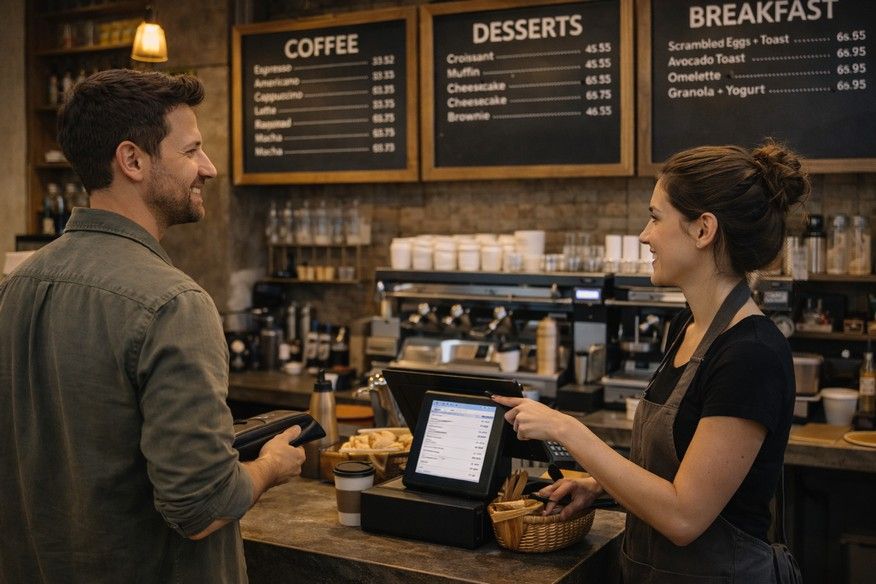
When positions are logically divided into categories, when names are clear, when there is no unnecessary information — the client feels control over the situation. And this means that he makes decisions more calmly and faster. For example, in a coffee shop it is much more effective to show: “Coffee”, “Desserts”, “Breakfast” than to try to impress with complex author's names without explanation. It's the same in the store: if a person immediately sees the logic — where drinks, where snacks, where basic goods — he does not get lost and spends more time inside.
A separate important detail — visibility of prices. When the prices are clearly indicated, the customer feels more confident. When you need to search for them or clarify — there is discomfort.
Modern formats, in particular electronic menus, work well precisely because they allow you to make the structure as clear as possible: categories, subcategories, clear positions. A person is not overloaded — he just chooses.
And here it is worth remembering a simple truth:
👉 the easier it is for the customer to choose, the more he buys.
Process convenience: speed = money
Even if the customer has already chosen a product or dish, this does not mean that the sale will take place.
Between “want to buy” and “bought” is another critical stage of the — process itself. And this is where business either makes or loses money.
Today, clients are not ready to wait, understand or overcome complex processes. They are used to speed. And if something goes wrong, they just refuse to buy.
The simplest example is — queue. A person went for coffee, saw that there were several people in front of him, the process moves slowly — and he leaves. Not because you have a bad product. And because it's a long time.
But it's not just about queues. Even without a client queue, “can stop” any incomprehensibility:
- Where to place an order?
- How to pay?
- Who to contact?
- What to do next?
As soon as a person starts thinking “and how does everything work here?” — a barrier appears.
Conversely: when the process is obvious, the sale is almost automatic. The customer went in → immediately realized that choose → quickly placed an order → easily paid for → received a purchase. Without unnecessary steps. No tension. No pauses. It is this simplicity that creates a feeling of comfort. And comfort directly affects money.
The faster and clearer the process, the more people make it to the purchase, the fewer customers “fall off, and the higher the total revenue.
And it is not about large investments or complex systems. Often it is enough to simply look at your business through the eyes of a client and honestly answer: is everything here really obvious? Because in modern business, the winner is not the one with more options, but the one with easier to buy.
Small details that have a big impact
There's one thing that's often underestimated in business: the customer doesn't remember the system, they remember the feeling. And this feeling is formed from small things. Not from global solutions, not from expensive repairs and not even always from the product. And from simple, almost imperceptible moments that either create comfort or destroy it.
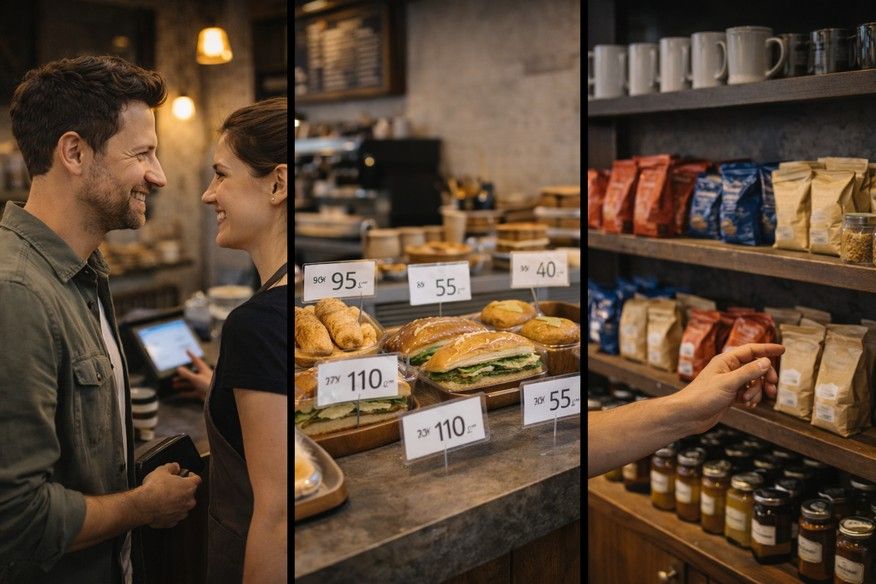
For example, the friendliness of the staff. It would seem obvious: you need to be polite. But in reality, the client very subtly feels the difference between “formally polite” and “humanly pleasing”. Short “good day”, eye contact, willingness to suggest — it takes seconds but makes you feel like you've been waiting here. And this greatly affects the decision to stay and buy.
Or another point — clarity of prices. When a customer sees a clear, open price, he has no internal tension. He is not afraid of a “surprise at the cash register”. It adds credibility. And vice versa: when prices need to be clarified, when they are small, hidden or look ambiguous — even if the product itself is good, a person subconsciously warns and postpones the purchase.
Another example of — is the logic of space. In a store or establishment, the client does not want to think about where to go and what to do. He expects everything to be intuitive. If the goods are laid out clearly, if there is a sense of order — the person relaxes. She starts watching, choosing, lingers longer. If the goods are arranged chaotically (for example, after choosing a pack of tea, you are forced to look for shelves with cookies for it), there is internal discomfort. And even if the client cannot explain why, he simply leaves such an institution faster.
These details seem like trifles. But they are the ones that form the overall impression. Important to understand:
👉 the client does not analyze — he feels.
He won't say: “I didn't like the logic of displaying the product”. He will say: “something there is not very” — and will not return.
That is why a business that works carefully and thoughtfully with details almost always wins. Not at the expense of one thing, but at the expense of the general feeling of comfort.
Common mistakes that cause you to lose customers
Many entrepreneurs are convinced that if customers have little — problem in advertising, prices or competition. But very often the reason is much closer. She — in daily small mistakes that accumulate and gradually repel people.
One of the most common — approach is “and so clearly”. It seems to the owner that everything is obvious: where is the menu, how to place an order, where is the cash register. But he looks at his business from the inside — and the client sees it for the first time. What is logical for you may not be clear for a new visitor.
Another common error is — overload. When there are too many options, when there is more information than necessary, when the client is forced to think for a long time — he simply gets tired and postpones the decision. And often it looks like a person is like “watching, choosing”... and then buying nothing.
Also common is the situation — lack of clear logic. The goods are placed without a system, the ordering process is not obvious, the actions are not consistent. The client has a feeling of insecurity. And uncertainty — is the main enemy of sales.
And another important thing is — indifference to the process. When the business works on the principle of “somehow it will”, without regular review, without analysis, without trying to improve the customer experience. In such cases, the owner may not even notice how many customers he loses every day.
And here you should ask yourself a simple question: what does my business look like through the eyes of a person who came in for the first time? Is everything clear to her? Is it easy for her? Do you want to stay? Because in most cases, customers do not go to competitors due to better conditions. They go where it's just more convenient.
And this is good news. Because the convenience of — is something you can really influence.
Everything is decided not by advertising, but by experience
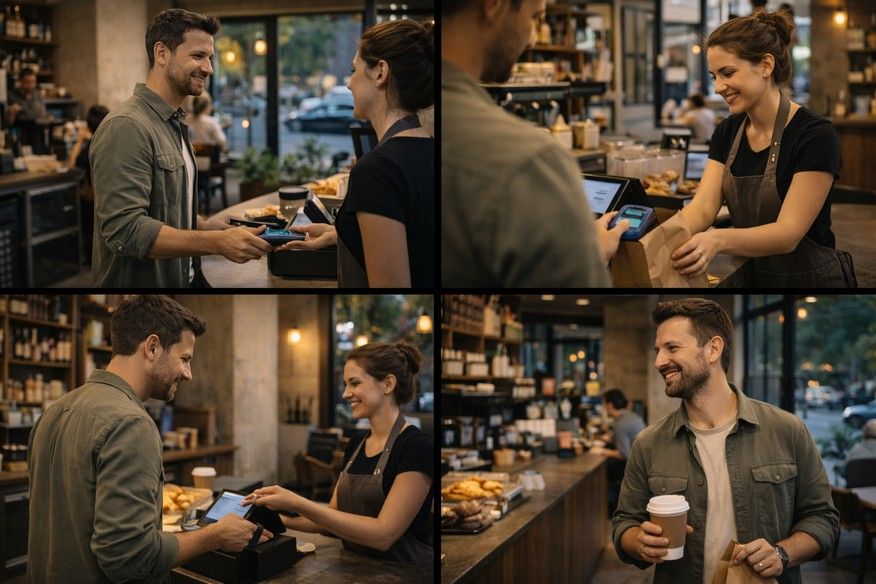
When the business has fewer customers, the first thought usually — requires more advertising. And that's logical. But advertising solves only half of the problem. She can lead a person. But whether she stays — is decided by experience.
To be honest, most customers don't disappear because of competitors or prices. They just get an uncomfortable, obscure or unpleasant — experience once and never come back.
Sometimes it's something very small: I had to wait a long time, it was not clear how to place an order, the prices were not obvious or did not match the price tags, or simply “did not go”. The client does not analyze it deeply. He does not write a list of reasons. He just chooses another seat next time.
That is why it is important to change the approach to sales. Selling — is not a payment moment. This is the entire path of the client: from the first look to receiving the purchase. And if this path is simple, clear and comfortable, a person will not only buy, but also return.
In this place, many business owners begin to notice an interesting pattern: as soon as it becomes more convenient —, revenue begins to grow. No sharp price increases, no aggressive advertising. Because more people get to the purchase, fewer customers “drop” in the process, repeat visits appear. And here it is important not to act at random, but to look at your business through numbers. That is why it is worth regularly analyzing:
- how many checks do you have in a day,
- at what hours are the most sales,
- where there are failures in the flow of customers.
Such data allows you not to guess, but to understand exactly what is happening in your — business and what needs to be changed. A systematic approach to this makes it possible not just to work, but to manage the situation: to see where you lose customers, and gradually correct it.
The main thing — to remember is a simple thing:
👉 the client does not choose the best business. He chooses the most convenient.
In the next article, we will talk about another important question: you brought a customer — but how to make him buy more? Let's figure out how promotions, discounts and combo offers work, and how to use them so that they bring profit, not reduce it.
Read Also


