How to stop living in an institution and start managing it
Why the constant presence of the owner — is a trap

Many owners of trade or food establishments often have the feeling that if I'm not here — something will go wrong. Someone will miss the check, someone will make a mistake, someone will just relax. And this feeling is quite understandable. Business — is always a risk and it is natural to want to keep everything under control. But there is an important point here, which is often not obvious: the constant physical presence of — is not control. This is only an illusion of control.
As long as you stand by, the processes really seem more stable. Staff work more closely, fewer mistakes, more discipline. But you should get — and the system starts working wrong. And this is not a problem of people. This is a problem of lack of a system.
In management, control is not seen as an observation of people, but as a way to reduce uncertainty. That is, it does not matter whether you are in place — is important, whether you can predict the outcome of the shift.
If the result depends on whether you are present or not — the business is not managed. It does not rest on processes, but on your personal participation.
And that's where the trap comes in: the more you try to control everything personally, the more the business depends on you. At some point, it starts to limit:
- you can't step away;
- can't scale;
- you can't trust a change without inner anxiety.
In fact, the problem is not that “staff is weak” or “everything needs to be followed”. The problem is that the control is not built correctly.
Strong control — is when you don't look at the process, but see the result. And this result is the same — regardless of whether you are in an institution.
What really needs to be controlled in the shift

When the owner says: “You need to control the change”, — is usually meant as everything: who works how, who does what, who talks to the client how, are there no mistakes. But in practice, this approach does not work. Because it is impossible to control everything.
There is a simple principle in modern management: it is not necessary to manage processes directly, but indicators. That is, not to look at what each employee does every minute, but to understand what result the whole change gives. A key idea that management research also confirms: without a measurement system, the manager is actually “blind”.
If you don't have clear numbers:
- you don't know which shift works better;
- don't understand where the losses are;
- you can't explain why today's result is worse than yesterday.
In such a situation, decisions are made by “on sensations”. And this is always a risk.
To make control work, it is enough to focus on a few key things.
First of all, — is sales. How much was done per change, what is the amount of revenue today and compared to other days.
Next — is checks. Not only the amount, but also the quantity. Because sometimes the problem is not that there are few customers, but that part of the sales simply do not go through the system.
And another important point of — is the stability of the result. If one change consistently shows a good result and the other — constantly “sags”, this is already a signal. And it is visible only in numbers.
That is why effective control of – is not a constant observation, but a regular analysis of specific indicators. You do not stand behind the workers — you look at the result of their work. It is this approach that allows you to gradually move away from manual control and move to system control.
How to see the real picture of changes through the numbers

At some point, each owner has the feeling that everything is working, but there is no certainty that it is working correctly. It seems that there are people on the spot, there are customers, the cash register is moving, but whether this is the maximum possible result or somewhere there are losses is difficult to say.
Here the difference between “observe” and “manage” is revealed. When you only have a feeling, you focus on the outside picture. If the change seems to be busy — it seems that everything is fine. If the staff is active — it seems that there are no problems. But research in management has long shown that without measurement, the manager actually does not see the real state of affairs. He sees only behavior, but not the result. The numbers change that completely.
Imagine the situation: you have two shifts — morning and evening. Both are practically the same: the same number of people, the same flow of customers, the same products. If you had just entered the hall, you would not have noticed a fundamental difference. But when you open reports on these changes in «Kavapp», the picture becomes clear. It turns out that the morning shift consistently makes, for example, 20% more revenue. And this is repeated not once, but regularly.
And here there is an important turning point in thinking. It's no longer “I think someone works better”. This is a specific fact. And these are the facts that allow you to manage your business.
You begin to see not just the overall result of the day, but how that result is formed. Where there are strong changes, where there are weak changes, where there is stability, and where there are chaotic fluctuations. And most importantly, — you can react not to emotions, but to deviations. If one change abruptly “asked”, this is no longer an assumption, but a signal. If the other consistently keeps a high level, it is also a signal —, but already that there is a correct work model.
This is how systemic control is built: not through presence, but through understanding the result.
Check and sales control: where losses are hidden
Very often, owners look only at the total amount of revenue. This is natural: the number is large, clear, it seems to show how the day has passed. But the problem is that this number can be misleading. Revenue — is already a consequence. To understand what is happening inside the change, you need to look at what it consists of. One of the most important indicators here is — number of checks.
Let's imagine the real situation. The owner opens the report and sees: today's revenue is almost the same as yesterday. At first glance, everything is stable. But if you look deeper, it turns out that yesterday there were 130 checks and today — is only 95. It means something has changed. And this “is something” more important than the revenue itself. Maybe today there were some big orders that “pulled out” amount. And maybe part of the sales were not made through the system at all. Or the change simply worked less actively: no additional positions were offered, rather “closed the client's”, no additional sales.
And this is where the main value of the numbers is manifested: they show what is not visible in the hall. Without this analysis, the owner might think: “Well, plus or minus the same result”. But in reality, the business is already losing money —, it's just not immediately obvious.
Conversely, there are situations when the revenue drops a little, but the number of checks increases. This may mean that the change works more actively with customers, but the average check sags. And this is a completely different management task.
In this way, control moves from the plane of suspicion to the plane of understanding. You don't check if everything is fine, but you see exactly where the problem arises and how it is reflected in the numbers.
Hourly analysis: when they work and when they just stand
There is another thing that is almost impossible to evaluate intuitively — is how staff work changes during the day. Even if you regularly visit the institution, you see only individual moments. And, as a rule, there is no complete picture. That is why hourly analysis gives a very strong effect.
For example, the owner is convinced that the establishment works evenly. There are morning customers, there is lunch, there is evening — more or less stable. But when he looks at the hourly sales report in «Kavapp», it turns out that the reality is different: from 12.00 to 14.00 — strong peak, it is expected, but from 15.00 to 17.30 — sharp failure. And not because there are no customers, but because the shift works more slowly: they serve longer, offer less, sometimes they just get tired after lunch.
Or another situation: the morning hours are potentially strong, but in fact give a weak result. And this is no longer a question of demand, but a question of work organization. Maybe the staff doesn't have time to get involved, maybe there aren't enough people, maybe the processes aren't set up.
Without numbers, it looks like “somewhere weaker, somewhere stronger”, with numbers it is already a clear map of the day. And it is this card that allows you to make decisions. You can change the schedule, strengthen specific hours, optimize the number of personnel. But the main thing is — you no longer work “on the sensations”.
And this once again confirms the key idea emphasized by modern management approaches: effective control — is not monitoring people, but working with data. When you have this data, presence in the institution ceases to be a requirement of control. You already understand what is happening — and what to do about it.
Who really works: how to evaluate the effectiveness of employees
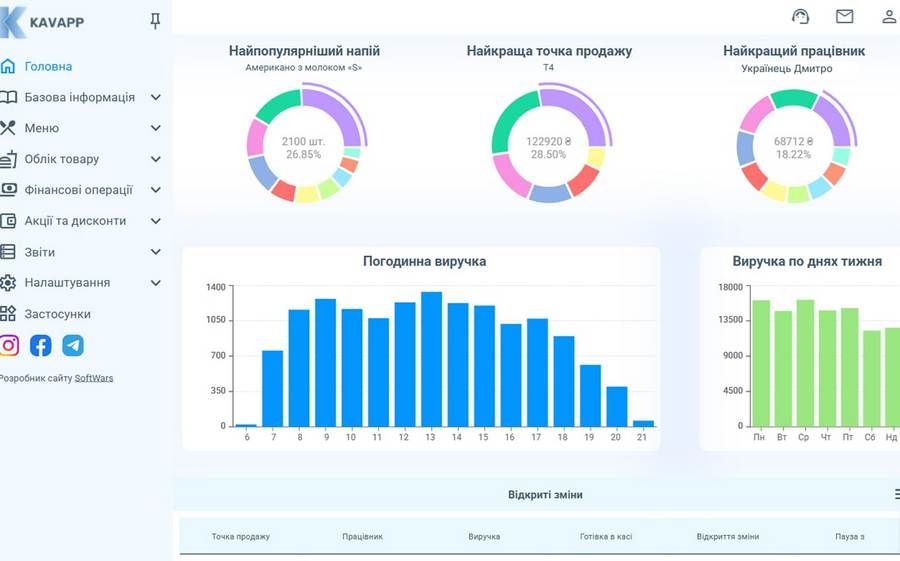
Another reason why owners cannot break away from the establishment, — is the feeling that without personal control it is impossible to understand who works well and who — does not. From the outside, everyone seems to be equally busy: they move, serve customers, fulfill their tasks. And at this point there is a classic error — evaluate efficiency by behavior.
In the psychology of management, this has long been described: employment is not equal to the result. A person can be constantly on the move, but not influence the final indicator of the business. Conversely — another employee can work more calmly, but bring much more benefit. That is why in modern management they do not look at “how ” work, but at “what result ” give.
In «Kavapp», this is made possible by employee performance statistics. It allows you to see what cannot be evaluated by eye.
Let's imagine the situation. Two cashiers work in the shift. Both are polite, both are quick to serve, no complaints from customers. If you look at the side — there is no difference. But when you open the report, it becomes clear that one of them makes significantly more checks per shift or generates a larger volume of sales. And it repeats itself over and over again. That is, there is a difference, it just does not lie on the surface. Perhaps one employee is more active in offering additional positions. Maybe it's better to communicate with the client. Maybe faster working during peak hours. You don't always see the cause, but you definitely see the result.
And this fundamentally changes management. Instead of subjective “, I think this worker is stronger”, you get an objective picture. And with it — the ability to make decisions: how to shape changes, who to put in peak hours, who should be taught or supported.
At the same time, it is important to understand one more thing that research confirms: controlling the effectiveness of — is not about punishment. If used correctly, it is a development tool. When you have numbers, you can not only find weaknesses, but also reinforce strengths. For example, figure out exactly what the best employee is doing and scale this approach to others. As a result, control ceases to be a pressure on staff and becomes a system that helps everyone work better.
Financial result of the change: revenue ≠ profit
There is another trap that even experienced owners fall into. It sounds very simple: if the revenue is good — then everything works well. But in reality it is not always so.
Revenue — is only the top layer. Behind it are expenses, salaries, collections, write-offs. And without taking into account these factors, it is impossible to understand whether the change is really effective.
Typical situation: on a day off, the establishment shows a high volume of sales. This seems to be a successful change. But when you look at the financial indicators, it becomes clear that along with the revenue, the costs have also increased: more staff, more write-offs, more additional costs. As a result, the real financial result is much more modest than it seems at first glance.
Conversely, there are situations when the revenue is not a record, but the change works very “purely”: without unnecessary costs, without losses, with good organization of processes. And as a result, it can be even more profitable.
That is why «Kavapp» has financial reports that allow you to look at the change more broadly than simply through sales. You see the movement of funds, expenses, collection — and you can estimate the real result.
This corresponds to the key principle of modern management: it is not turnover that needs to be managed, but efficiency. And when you start looking at change from this perspective, a lot of things become obvious. Some “successful” changes are not so profitable, and some underrated —, on the contrary, show a strong result.
How to build a control system without constant control
When all these tools are combined (shift reports, check analysis, hourly dynamics, employee performance, financial performance) the main – system appears. And it is the system that allows the owner to stop being a supervisor and become a manager.
There is an important balance in management psychology: excessive control demotivates, and its absence creates chaos. An efficient business is always in the middle of — where there are clear rules and transparent indicators.
In practice, it is quite simple. You are not trying to control every action of the employee. You regularly look at the results. For example, you analyze changes for a day or a week, compare them with each other, determine where deviations appear. If everything is stable — you do not interfere. If you see the — problem, you already have a basis for the solution.
For example, if one change systemically subsides —, this is a reason to figure it out. If there are failures — at specific hours, this is a signal to change the organization of work. If individual workers consistently give a weaker result — it is a matter of training or redistribution of roles.
And the most important thing is that — you do it is not “per eye”, but based on the data.
As a result, a very important transformation takes place. You are no longer physically attached to the facility. You don't need to be present to understand what's going on. Control becomes not an action, but a system. And this is what allows the business to grow without the constant involvement of the owner.
Control — is not a presence, but a system

If you look at everything together, it becomes obvious: the problem with most owners is not that they do not control the business enough. On the contrary, — they try to control too much and too manually. Hence the feeling that nothing will work without constant presence. But in reality, this is only a consequence of the fact that control is built on the wrong principles.
The modern approach to management says very clearly: control — is not monitoring people, but managing the result. And this result should be measurable, understandable and regular.
When you have numbers, the situation changes dramatically. You no longer focus on the mood of change or your own impressions. You see how each shift works, how the number of checks changes, at what hours there are peaks and dips, which employees really influence the result, and which simply creates the appearance of work. And most importantly — you understand how all this affects the final financial result. At this point, control ceases to be a check and becomes a management system.
And here another thing is important. This approach does not destroy trust in the — team, on the contrary, it strengthens it. When the rules are the same for everyone, when the result is measured transparently, subjectivity disappears. Employees understand what they are being evaluated for, and you — what your decisions are based on. This is the balance that management psychologists talk about: not total control and not complete freedom, but a clear system in which everyone knows their orientations.
As a result, not only the method of control changes, but also the role of the owner. You cease to be the person who keeps everything to himself. Instead, you become the one who configures the system, analyzes the results, and makes decisions. And this is what opens up the opportunity to move on — to develop business, scale, launch new directions. Because a strong business — is not one that works only in your presence. A strong business — is one that works stably even when you are not around.
Read Also


